Thursday, May 22, 2008

Friday, May 16, 2008
Letter to Friend
Dear Friend,
Our huts in Valley Forge are very small. Each hut has 12 men in it, and also each person only has enough room for themselves. Although we still have heat, its brought to our bodies from the stone fireplace we have. The floors are very dirty and only a cloth that covers the door opening, which makes it very cold in the room. It was easy to house all of the soldiers, but its hard to keep clothes on us, and keep us fed. But we are managing. It is hard to keep warm, even with the fireplace. The temperatures stay pretty close to the 20's and 30's. Six weeks of snow and rain is really starting to make everyone sick, but we have to try and stay strong for our country.
I like that we have a hospital now for the military, which is in Yellow Springs. Now we can have our men get help. Most of them are getting sick because of bad hygiene. The only way that we can wash up is in the Schuylkill River, and creeks. Thats also our source for getting water to drink. We have up to 3,000 and 4,000 soldiers that have been vaccinated.
Our huts in Valley Forge are very small. Each hut has 12 men in it, and also each person only has enough room for themselves. Although we still have heat, its brought to our bodies from the stone fireplace we have. The floors are very dirty and only a cloth that covers the door opening, which makes it very cold in the room. It was easy to house all of the soldiers, but its hard to keep clothes on us, and keep us fed. But we are managing. It is hard to keep warm, even with the fireplace. The temperatures stay pretty close to the 20's and 30's. Six weeks of snow and rain is really starting to make everyone sick, but we have to try and stay strong for our country.
I like that we have a hospital now for the military, which is in Yellow Springs. Now we can have our men get help. Most of them are getting sick because of bad hygiene. The only way that we can wash up is in the Schuylkill River, and creeks. Thats also our source for getting water to drink. We have up to 3,000 and 4,000 soldiers that have been vaccinated.
Wednesday, April 30, 2008
Aaron Burr

Aaron Burr was born in New Jersey on February 6, 1756, and died on September 14, 1836. His father was Reverend Aaron Burr, who was the President of the College of New Jersey, which later became Princeton. Burr's mother was Esther Edwards Burr, who was the daughter of Jonathan Edwards. Edwards helped the religious movement known as, Great Awakening. Aaron Burr became an orphan at the age of 2, his uncle Timothy Edwards became his caretaker. Aaron started to apply for colleges at age 11, he knew that he was smart enough to get in, but got turned down. At age 13 Burr tried again and got accepted as a sophomore. Burr graduated from college at age 17.
Burr was 19 when the Revolution started, he wanted to join George Washingtons (commander-in-chief of Continental Army)commisson, but he got turned down. So instead he went to
Burr was the 3rd Vice President of the United States of America from March 4, 1801 thru March 4, 1805. The President at the time was Thomas Jefferson, the Vice President before Burr was Thomas Jefferson. After Burr finished his term the following Vice President was George Clinton. He was the Senator for New York during the time of March 4, 1791 thru March 3, 1797. Before and after Burr was the Senator, Philip Schuyler-- was the Senator.
Burr was offered to publish articles for Alexander Hamilton, of which was a long time politcal rival. Hamilton and Burr got into a duel challenge together. The duel started on the 11th of July in 1804 Heights of Weehawken in New Jersey. Burr got charged for the murder of Hamilton in both New York and New Jersey.
Burr was offered to publish articles for Alexander Hamilton, of which was a long time politcal rival. Hamilton and Burr got into a duel challenge together. The duel started on the 11th of July in 1804 Heights of Weehawken in New Jersey. Burr got charged for the murder of Hamilton in both New York and New Jersey.
Wednesday, April 9, 2008
ASI Exam 4 Essay Part 1 Closing statement
Gentlemen of The Jury;
These men are guilty. To sum up all of the events that happen to make me come to this conclusion is that the British killed 5 citizens. The guy who was in charge of the British soldiers was Captian Thomas Preston. When a fight broke out in town, teens were causing problem and was wanting to fight. When help was needed the citizens went to the church and made the bell ring. Others thought that there was a fire, but then they soon found out that it was a fight. The soldiers were commanded by their Captain. The Captain hollered out to all the men to "FIRE!" and they did so.
Captain Thomas Preston is at fault for what happened. He allowed his men to shoot at possible innocent people.
Thomas should be hung for his crime of killing innocent people.
These men are guilty. To sum up all of the events that happen to make me come to this conclusion is that the British killed 5 citizens. The guy who was in charge of the British soldiers was Captian Thomas Preston. When a fight broke out in town, teens were causing problem and was wanting to fight. When help was needed the citizens went to the church and made the bell ring. Others thought that there was a fire, but then they soon found out that it was a fight. The soldiers were commanded by their Captain. The Captain hollered out to all the men to "FIRE!" and they did so.
Captain Thomas Preston is at fault for what happened. He allowed his men to shoot at possible innocent people.
Thomas should be hung for his crime of killing innocent people.
Tuesday, April 1, 2008
Q4 Notes
humanities-for-jules.blogspot.com
Revolution and War
1763-1789
Revolution Notes
1763—Proclamation Act
1764—Grenville Acts (direct tax)
Sugar (molasses, wine)
Stamp

Quartering
Currency
Virtual/ Direct Representation
1765—Stamp Act Congress
Sons of Liberty
Samuel Adams
Paul Revere
John Hancock
Propaganda

Boycotts
Lobsters (Lobster-backs, Thomas Lobster)
1766—Declaratory Act
1767—Townsend Acts (indirect tax)
Charles Townsend
Writs of Assistance (search warrants)
Revenue used to pay Royal officials in the colonies
Tea Act (glass, paper, paint) support British East India Company
1770—Boston Massacre
 - Paul Revere made picture.
March 5, 1770
Local reaction (primarily)
5 dead colonists
John Adams defends British soldiers/5 exonerated-2 convicted
Convicted men discharged and thumbs branded
1773—Boston Tea Party

November 30, 1773--Dartmouth sails into Boston Harbor
December 16, 1773--Tea dumped into harbor
340 chests of tea dumped (value of 10,000 British pounds)
1774—Intolerable Acts (Coercive Acts in Britain)
Close the port of Boston
Shut down Provincial and Town Governments
All offices appointed
Named General Thomas Gage as Governor
Gave all western lands north of the Ohio R. to Quebec, allowed Catholic Church to practice
1774—1st Continental Congress
September to October (7 weeks)
Carpenter’s Hall, Philadelphia
New England—John Adams, Paul Revere, Silas Deane
Virginia—Washington, Patrick Henry, Peyton Randolph, Richard Henry Lee
Pennsylvania—John Dickinson, Joseph Galloway (Plan for American council under Parliament, to avoid war)
New York—John Jay, James Duane
Maryland—Samuel Chase (future Supreme Court Justice), Charles Carroll (richest man in
Maryland, Catholic)
Declaration of Rights—rejects Parliamentary authority over internal colonial affairs, colonies
manage own defense, united aid to Boston if Intolerable Acts continue, absolute boycott of
British goods to be enforced rigidly
1775— January
William Pitt urges Parliament to withdraw troops from America because the idea of managing
the colonies through force was “too ridiculous to take up a moment of your lordships’ time”
1775—April 19 Lexington and Concord
Gen. Gage sends 700 men to Concord to seize the powder supplies
Paul Revere and William Dawes raise alarm the night before
Town of Lexington is on the way to Concord
Minutemen are assembled on the town common
“Shot heard round the world”
18 colonials killed and the rest run away
British march on to Concord and find the munitions were moved overnight
Minutemen ambush the British the whole way back to Boston
430 Redcoats make it back to Boston
30,000 Colonists surround Boston
1775—May
Gen. Howe, Gen. Clinton, Gen. Burgoyne
5,000 British troops
Ethan Allen, “Green Mountain Boys” seize Fort Ticonderoga
Henry Knox uses canon to lay siege on Boston
Benedict Arnold (Connecticut) takes Fort Crown Point to impede an invasion from Canada
1775—May 10, 2nd Continental Congress
Sam Adams pushes for Independence
John Dickenson (Penn.) urges restraint
Agree to form Colonial Army
Delegates unanimously agree to Washington as Commander of Continental Army (John Adams
suggestion)
1775—June 17, “Battle of Bunker Hill”
Actually fought on Breed’s Hill
Gen. Howe leads assault without canon support (his canon had been matched with wrong-sized
cannonballs [Amherst at Ticonderoga])
Militia waited to within 30 yards (some say 15 yards)
Militia target British officers
Militia ran extremely low on ammunition
On the third assault, led by Gen. Howe, British troops overtake the colonial position
Britain losses almost 1000 men (about half the attacking force)
Colonials lose about 500 men
1776—January, Common Sense
Written by Thomas Paine
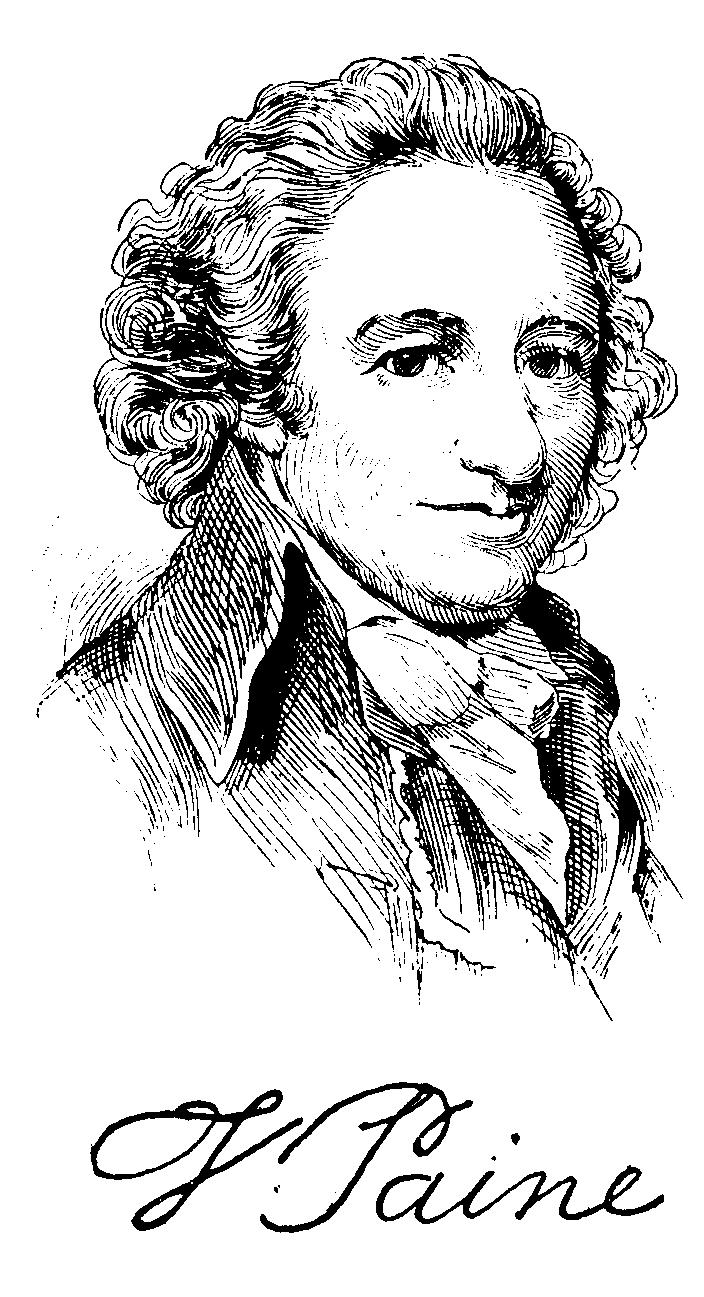
120,000 copies sold in three months
1776—March
Gen. William Howe evacuates Boston
July 2, lands in Staten Island, New York (Loyalist base)
1776—Declaration of Independence
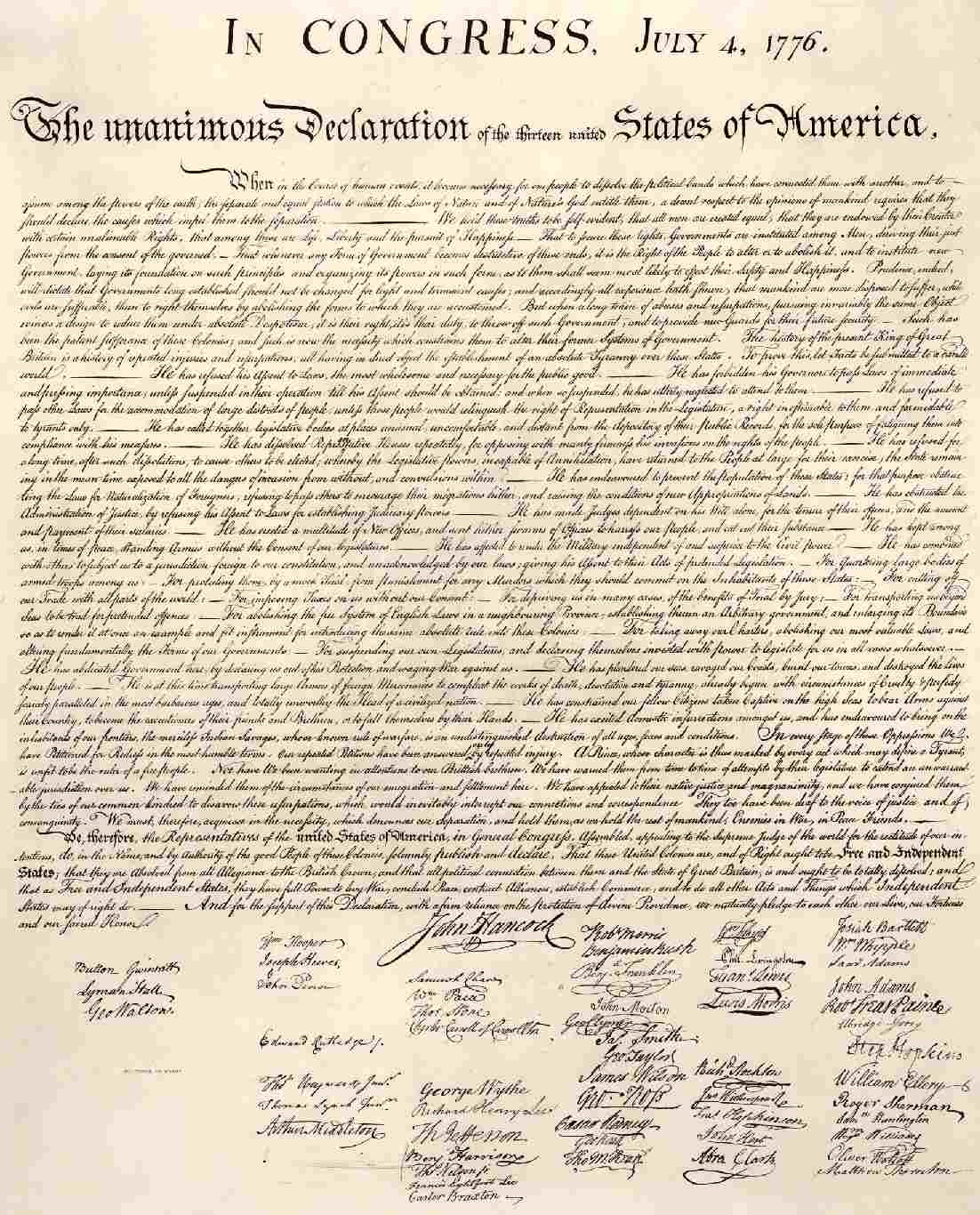
June 7, Richard Henry Lee (Virginia) introduces legislation to declare independence from Britain
Before voting on Lee’s proposal Congress appoints five-man committee to draft a formal
Declaration of Independence (Thomas Jefferson, 33, does most of the writing)
June 28, Declaration presented to Congress
July 2, Congress approves Lee’s legislation to declare the United States of America independent
of Great Britain
July 4, Congress officially adopts the Declaration of Independence
The Declaration intended to:
Undermine loyalty to King George III
Outline basic principles of representative government
Establish the “right” of rebellion
War
1776—August, Brooklyn Heights, New York
Largest Naval group Britain will launch until the 20th century
British victory, city falls to England
As winter came “sunshine patriots” left the American Army
Initial colonial enlistments due to expire
1776—December, Battle of Trenton

Howe believes war almost won
1,400 Hessians stationed at Trenton
Colonel Rall (Hessian) builds no fortifications
Washington “Crosses the Delaware” Christmas night
2,500 men; 18 artillery guns
Surprise attack at dawn
106 Hessians killed, 918 captured
No colonial casualties
Washington retreats in secret to avoid Gen. Cornwallis counter-attack
1777—January, Princeton
Washington ambushes British troops
Colonial victory establishes this will not be a quick war for Britain
1777—September-October, Saratoga
Gen. Burgoyne plans a three-prong attack on colonials at Albany
Plan does not consider the terrain, forcing British troops to march through swamps, lakes, hills
and forests full of rebels
Two of the three “prongs” never arrive (Howe goes to Philadelphia instead, St. Leger retreats to
New York afraid of Benedict Arnold)
Sept. Burgoyne crosses Hudson River
Oct. 17, Burgoyne surrenders
Establishes American Army as real threat
Helps secure open French Alliance
Turning Point of the War
1777-1778—Winter at Valley Forge
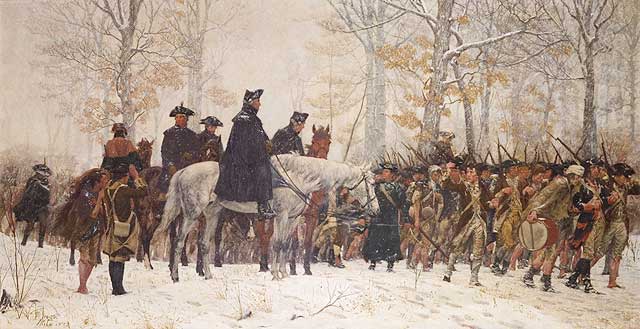
Under-funded troops
Low morale
10,000+ troops
4,000 troops listed as “unfit for duty” due to poor supplies (boots, blankets, coats, etc.)
2,500 troops die of disease (typhus, typhoid fever, dysentery, pneumonia)
George Washington mentioned a lack of shoes so severe that the men's "marches might be
tracked by the blood from their feet”
Local farmers would sell produce to Brits who could pay cash
1779—February, Vincennes
1780—August, Camden
1780—October, Kings Mountain
1781—October, Yorktown

British Gen. Cornwallis
American Gen. Washington (also “Mad” Anthony Wayne, Baron von Steuben)
French Gen. Rochambeau (also Marquis de Lafayette)
Essentially a French Naval victory
Last significant battle of the war
1783—Sept. 3, Treaty of Paris
Britain recognizes American independence
America gets all land from Atlantic coast to Miss. River, Great Lakes to Florida
Fishing rights to the Gulf of Saint Lawrence and off the coast of Newfoundland
America must pay debts to Britain
American congress would “earnestly recommend” all Loyalist property returned (States ignore this request)
Revolution and War
1763-1789
Revolution Notes
1763—Proclamation Act
A line that is a divider that shows or tell where the Indians can have and the Britians cant take, this line is the Applacachian Mountains- Mississippi Mountains Indians, Appalachian to ocean is the Britians.
1764—Grenville Acts (direct tax)
Sugar (molasses, wine)
Stamp
Quartering
Currency
Virtual/ Direct Representation
Direct tax of stamps and sugars.
1765—Stamp Act Congress
Sons of Liberty
Samuel Adams
Paul Revere
John Hancock
Propaganda
Boycotts
Lobsters (Lobster-backs, Thomas Lobster)
1766—Declaratory Act
1767—Townsend Acts (indirect tax)
Charles Townsend
Writs of Assistance (search warrants)
Revenue used to pay Royal officials in the colonies
Tea Act (glass, paper, paint) support British East India Company
1770—Boston Massacre
- Paul Revere made picture.March 5, 1770
Local reaction (primarily)
5 dead colonists
John Adams defends British soldiers/5 exonerated-2 convicted
Convicted men discharged and thumbs branded
1773—Boston Tea Party
November 30, 1773--Dartmouth sails into Boston Harbor
December 16, 1773--Tea dumped into harbor
340 chests of tea dumped (value of 10,000 British pounds)
1774—Intolerable Acts (Coercive Acts in Britain)
Close the port of Boston
Shut down Provincial and Town Governments
All offices appointed
Named General Thomas Gage as Governor
Gave all western lands north of the Ohio R. to Quebec, allowed Catholic Church to practice
1774—1st Continental Congress
September to October (7 weeks)
Carpenter’s Hall, Philadelphia
New England—John Adams, Paul Revere, Silas Deane
Virginia—Washington, Patrick Henry, Peyton Randolph, Richard Henry Lee
Pennsylvania—John Dickinson, Joseph Galloway (Plan for American council under Parliament, to avoid war)
New York—John Jay, James Duane
Maryland—Samuel Chase (future Supreme Court Justice), Charles Carroll (richest man in
Maryland, Catholic)
Declaration of Rights—rejects Parliamentary authority over internal colonial affairs, colonies
manage own defense, united aid to Boston if Intolerable Acts continue, absolute boycott of
British goods to be enforced rigidly
1775— January
William Pitt urges Parliament to withdraw troops from America because the idea of managing
the colonies through force was “too ridiculous to take up a moment of your lordships’ time”
1775—April 19 Lexington and Concord
Gen. Gage sends 700 men to Concord to seize the powder supplies
Paul Revere and William Dawes raise alarm the night before
Town of Lexington is on the way to Concord
Minutemen are assembled on the town common
“Shot heard round the world”
18 colonials killed and the rest run away
British march on to Concord and find the munitions were moved overnight
Minutemen ambush the British the whole way back to Boston
430 Redcoats make it back to Boston
30,000 Colonists surround Boston
1775—May
Gen. Howe, Gen. Clinton, Gen. Burgoyne
5,000 British troops
Ethan Allen, “Green Mountain Boys” seize Fort Ticonderoga
Henry Knox uses canon to lay siege on Boston
Benedict Arnold (Connecticut) takes Fort Crown Point to impede an invasion from Canada
1775—May 10, 2nd Continental Congress
Sam Adams pushes for Independence
John Dickenson (Penn.) urges restraint
Agree to form Colonial Army
Delegates unanimously agree to Washington as Commander of Continental Army (John Adams
suggestion)
1775—June 17, “Battle of Bunker Hill”
Actually fought on Breed’s Hill
Gen. Howe leads assault without canon support (his canon had been matched with wrong-sized
cannonballs [Amherst at Ticonderoga])
Militia waited to within 30 yards (some say 15 yards)
Militia target British officers
Militia ran extremely low on ammunition
On the third assault, led by Gen. Howe, British troops overtake the colonial position
Britain losses almost 1000 men (about half the attacking force)
Colonials lose about 500 men
1776—January, Common Sense
Written by Thomas Paine
120,000 copies sold in three months
1776—March
Gen. William Howe evacuates Boston
July 2, lands in Staten Island, New York (Loyalist base)
1776—Declaration of Independence
June 7, Richard Henry Lee (Virginia) introduces legislation to declare independence from Britain
Before voting on Lee’s proposal Congress appoints five-man committee to draft a formal
Declaration of Independence (Thomas Jefferson, 33, does most of the writing)
June 28, Declaration presented to Congress
July 2, Congress approves Lee’s legislation to declare the United States of America independent
of Great Britain
July 4, Congress officially adopts the Declaration of Independence
The Declaration intended to:
Undermine loyalty to King George III
Outline basic principles of representative government
Establish the “right” of rebellion
War
1776—August, Brooklyn Heights, New York
Largest Naval group Britain will launch until the 20th century
British victory, city falls to England
As winter came “sunshine patriots” left the American Army
Initial colonial enlistments due to expire
1776—December, Battle of Trenton
Howe believes war almost won
1,400 Hessians stationed at Trenton
Colonel Rall (Hessian) builds no fortifications
Washington “Crosses the Delaware” Christmas night
2,500 men; 18 artillery guns
Surprise attack at dawn
106 Hessians killed, 918 captured
No colonial casualties
Washington retreats in secret to avoid Gen. Cornwallis counter-attack
1777—January, Princeton
Washington ambushes British troops
Colonial victory establishes this will not be a quick war for Britain
1777—September-October, Saratoga
Gen. Burgoyne plans a three-prong attack on colonials at Albany
Plan does not consider the terrain, forcing British troops to march through swamps, lakes, hills
and forests full of rebels
Two of the three “prongs” never arrive (Howe goes to Philadelphia instead, St. Leger retreats to
New York afraid of Benedict Arnold)
Sept. Burgoyne crosses Hudson River
Oct. 17, Burgoyne surrenders
Establishes American Army as real threat
Helps secure open French Alliance
Turning Point of the War
1777-1778—Winter at Valley Forge
Under-funded troops
Low morale
10,000+ troops
4,000 troops listed as “unfit for duty” due to poor supplies (boots, blankets, coats, etc.)
2,500 troops die of disease (typhus, typhoid fever, dysentery, pneumonia)
George Washington mentioned a lack of shoes so severe that the men's "marches might be
tracked by the blood from their feet”
Local farmers would sell produce to Brits who could pay cash
1779—February, Vincennes
1780—August, Camden
1780—October, Kings Mountain
1781—October, Yorktown
British Gen. Cornwallis
American Gen. Washington (also “Mad” Anthony Wayne, Baron von Steuben)
French Gen. Rochambeau (also Marquis de Lafayette)
Essentially a French Naval victory
Last significant battle of the war
1783—Sept. 3, Treaty of Paris
Britain recognizes American independence
America gets all land from Atlantic coast to Miss. River, Great Lakes to Florida
Fishing rights to the Gulf of Saint Lawrence and off the coast of Newfoundland
America must pay debts to Britain
American congress would “earnestly recommend” all Loyalist property returned (States ignore this request)
Thursday, March 6, 2008
Plymouth Exam Essay!
Miles Standish contributed important protection to the early colonies by using violence. Benjamin Church provided vital leadership to protect the colonies during King Philip's War. Despite all of this violence, the colonies were also founded on religious idealism. It is important to understand the full history of these areas because this is what Americans generally consider to be our nation's beginning.
Standish provided important protection using violence for the early colonies. One of the many things that he did was broke into a wigwam (of which is like a home for the indian families) looking for Squanto. After inviting others to a pork dinner Standish stabbed one of the men that sat across the table of him, with the mans own sword. He was so set against the pilgrims and them being on the Indians land, that he killed any Indian that he saw with the pilgrims, to show the other Indians that if they are seen with a pilgrim they would be killed also. Standish strongly showed that violence was pretty much the only protection for early colonies.
Benjamin Church provided important leadership to protect the colonies during King Philip's War, because without a strong leadership the colonies would not have a strong colonie. Church had been protected by Philip, so when Philip was killed he wanted to make sure everyone had known that he was going to follow in Philip's leadership footsteps. After King Philips death Church and his men put the Kings head on a pike, so that the townspeople understood that the King would still be there no matter what. When Church found out where Annawon and his men had been hiding out he took Annawon, the 60 men, and his own 6 men to the town to show everyone that Annawon was alive. Church and Annawon had understood each other even though Annawon did not speak english. Church had made sure that Annawon knew that as long as Church could control it that his men and himself would live. When Church had to leave for a mission the townspeople killed Annawon and his men. When Church came back and found out that they had killed Annawon he was pretty upset, because Annawon was a good guy. This all shows that Church provide important leadership because Church let the whole town know that when Philip died he was not going to give up, and same for when Annawon came back to the town with him.
Even with all the violence the colonies also was founded with religious idealism. Puritans started coming to the colonies between the years of 1630 and 164o, and when they got there that wanted to be the "city on a hill" meaning that they wanted to be the center of attention. They started the blue laws and having a religion in the colonie. The blue laws consist of No Shaving, No hunting, No Shopping, No fishing. This was all for Sundays because that was the day of rest, and if you was clean shaved for Sunday it would not be right. It meant that you did not rest, and you did not follow the laws. These were all religious traits, and were not all about viloence.
The combination of idealism and viloence was combined in the English colonies which is now Massachusetts. Violence was the only protection for early colonies, and Standish was the one to show it. Church provided leadership that was important becuase he showed the whole town that after Philip's death Church was not going to give up. The blue laws made it so that Sunday was a day of rest, and it brought religious features into the colonies. All this information is important because it shows how viloence had protected a lot of people, and how little things that the blue laws consisted of could change a lot of things.
Standish provided important protection using violence for the early colonies. One of the many things that he did was broke into a wigwam (of which is like a home for the indian families) looking for Squanto. After inviting others to a pork dinner Standish stabbed one of the men that sat across the table of him, with the mans own sword. He was so set against the pilgrims and them being on the Indians land, that he killed any Indian that he saw with the pilgrims, to show the other Indians that if they are seen with a pilgrim they would be killed also. Standish strongly showed that violence was pretty much the only protection for early colonies.
Benjamin Church provided important leadership to protect the colonies during King Philip's War, because without a strong leadership the colonies would not have a strong colonie. Church had been protected by Philip, so when Philip was killed he wanted to make sure everyone had known that he was going to follow in Philip's leadership footsteps. After King Philips death Church and his men put the Kings head on a pike, so that the townspeople understood that the King would still be there no matter what. When Church found out where Annawon and his men had been hiding out he took Annawon, the 60 men, and his own 6 men to the town to show everyone that Annawon was alive. Church and Annawon had understood each other even though Annawon did not speak english. Church had made sure that Annawon knew that as long as Church could control it that his men and himself would live. When Church had to leave for a mission the townspeople killed Annawon and his men. When Church came back and found out that they had killed Annawon he was pretty upset, because Annawon was a good guy. This all shows that Church provide important leadership because Church let the whole town know that when Philip died he was not going to give up, and same for when Annawon came back to the town with him.
Even with all the violence the colonies also was founded with religious idealism. Puritans started coming to the colonies between the years of 1630 and 164o, and when they got there that wanted to be the "city on a hill" meaning that they wanted to be the center of attention. They started the blue laws and having a religion in the colonie. The blue laws consist of No Shaving, No hunting, No Shopping, No fishing. This was all for Sundays because that was the day of rest, and if you was clean shaved for Sunday it would not be right. It meant that you did not rest, and you did not follow the laws. These were all religious traits, and were not all about viloence.
The combination of idealism and viloence was combined in the English colonies which is now Massachusetts. Violence was the only protection for early colonies, and Standish was the one to show it. Church provided leadership that was important becuase he showed the whole town that after Philip's death Church was not going to give up. The blue laws made it so that Sunday was a day of rest, and it brought religious features into the colonies. All this information is important because it shows how viloence had protected a lot of people, and how little things that the blue laws consisted of could change a lot of things.
Tuesday, March 4, 2008
Plymouth Exam Outline
Outline for Plymouth Essay
I. Introduction
A. Thesis: The founding of English colonies in modern Massachusetts combined a strange mix of idealism and violence.
B. First Major Point: Miles Standish contributed important protection to the early colonies by using violence.
C. Second Major Point: Benjamin Church provided vital leadership to protect the colonies during King Philip's War.
D. Third Major Point: Despite all of this violence, the colonies were also founded on religious idealism.
E. Significance of Thesis: It is important to understand the full history of these areas because this is what Americans generally consider to be our nation's beginning.
II. First Major Point
A. Miles Standish contributed important protection to the early colonies by using violence.
B. Broke into a wigwam looking for Squanto.
C. stabbed a person across the table after inviting him to a pork dinner
D. killed any indians he saw with the pilgrims.
E. Significance of position (how it relates to thesis?)
III. Second Major Point
A. Benjamin Church provided vital leadership to protect the colonies during King Philip's War
B. Got protected by King Philip
C. Took Annawon and 60 men with his 6.
D. Putting King Philips head on top of the pike in the middle town
E. Significance of position (how it relates to thesis?)
IV. Third Major Point
A. Despite all of this violence, the colonies were also founded on religious idealism
B. City on top of Hill
C. Blue Laws
D.
E. Significance of position (how it relates to thesis?)
V. Conclusion
A. Restate thesis (not re-write)
B. Restate significance of first position
C. Restate significance of second position
D. Restate significance of third position
E. Summary of paper (why is it important)
I. Introduction
A. Thesis: The founding of English colonies in modern Massachusetts combined a strange mix of idealism and violence.
B. First Major Point: Miles Standish contributed important protection to the early colonies by using violence.
C. Second Major Point: Benjamin Church provided vital leadership to protect the colonies during King Philip's War.
D. Third Major Point: Despite all of this violence, the colonies were also founded on religious idealism.
E. Significance of Thesis: It is important to understand the full history of these areas because this is what Americans generally consider to be our nation's beginning.
II. First Major Point
A. Miles Standish contributed important protection to the early colonies by using violence.
B. Broke into a wigwam looking for Squanto.
C. stabbed a person across the table after inviting him to a pork dinner
D. killed any indians he saw with the pilgrims.
E. Significance of position (how it relates to thesis?)
III. Second Major Point
A. Benjamin Church provided vital leadership to protect the colonies during King Philip's War
B. Got protected by King Philip
C. Took Annawon and 60 men with his 6.
D. Putting King Philips head on top of the pike in the middle town
E. Significance of position (how it relates to thesis?)
IV. Third Major Point
A. Despite all of this violence, the colonies were also founded on religious idealism
B. City on top of Hill
C. Blue Laws
D.
E. Significance of position (how it relates to thesis?)
V. Conclusion
A. Restate thesis (not re-write)
B. Restate significance of first position
C. Restate significance of second position
D. Restate significance of third position
E. Summary of paper (why is it important)
Thursday, January 31, 2008
Wounded Knee Essay
Wounded Knee illustrates one of the final events in a long series of violent conflicts motivated by racism, disrespect and lack of understanding.
I. Introduction
A. Wounded Knee illustrates one of the final events in a long series of violent conflicts motivated by racism, disrespect and lack of understanding.
B. Wounded Knee Essay off blog on nokomishistory.com -- tells about the soldiers and what they went through in detailed writing.
C. Wounded Knee Video From Youtube -- is also about the things the families went through but has pictures to go with it thats full of details.
D. Monument Video From Youtube -- Tells about the monument and why its important.
E. These sources are important because they give good details about what happened to soldiers and indian families, and the members they lost and how soldiers treated indians.
II. Body of Essay
A.
B. Detail 1 (cited)
C. Detail 2 (cited)
D. Detail 3 (cited)
E. Significance of details
III. Conclusion
A. Restate Thesis (not rewrite)
B. lesson learned
C. lesson learned
D. lesson learned
E. Significance of thesis
Leader- Big Foot
I. Introduction
A. Wounded Knee illustrates one of the final events in a long series of violent conflicts motivated by racism, disrespect and lack of understanding.
B. Wounded Knee Essay off blog on nokomishistory.com -- tells about the soldiers and what they went through in detailed writing.
C. Wounded Knee Video From Youtube -- is also about the things the families went through but has pictures to go with it thats full of details.
D. Monument Video From Youtube -- Tells about the monument and why its important.
E. These sources are important because they give good details about what happened to soldiers and indian families, and the members they lost and how soldiers treated indians.
II. Body of Essay
A.
B. Detail 1 (cited)
C. Detail 2 (cited)
D. Detail 3 (cited)
E. Significance of details
III. Conclusion
A. Restate Thesis (not rewrite)
B. lesson learned
C. lesson learned
D. lesson learned
E. Significance of thesis
Leader- Big Foot
Tuesday, January 22, 2008
Final Prompt # 3
Mao was a dictator and it showed because he ruled over what anyone wanted or tried to say. Everyone wanted to become like him. Stalin also was a dictator, I am not sure how he became powerful. People also looked up to Stalin. Hilter became powerful because he fooled Roosevelt and Stalin into thinking they were all in it together. Once Hitler got the paper signed that he needed he became the ruler of Germany and no one could do anything about it. Not many people liked Hitler after what he did by fooling Stalin. Dictatorship usually always happens when someone gets really greedy and want to rule everyone. Most of the Dictators find a way to do gain power without anyone knowing and then "BAM" all of a sudden they have Dictatorship as there government. The recurring signs is that when a dictator wants something he usually gets it. No matters what it takes.
Tuesday, January 15, 2008
Book Portfolio
George and Lennie were so close to each other that where ever one of them went the other followed. George takes care of Lennie so nothing happens to him. George and Lennie are quiet different from each other. George is the smarter one, but is small. Lennie is big in size, but has a mind of a younger child. Having a mind of a younger child is that Lennie does not think before he acts. They are migrant workers, meaning that they move from place to place finding work. They never find a steady job. Of Mice and Men is a realistic fiction book by John Steinbeck. John Steinbeck was one of the best-known writers in the 20th century. Of Mice and Men was released in 1939. The book shows that friendship is a very powerful thing. Steinbeck shows this by the way George and Lennie are so close. They are pretty much like brothers. George is always telling Lennie what to do and what not to do for Lennie’s own sake. George doesn’t want Lennie to get in any trouble when they get this good job at a ranch in Salinas Valley.
The ranch in Salinas Valley is where George and Lennie go to work. Salinas Valley is in California, it lies close to the Salinas River. Strawberries, lettuce, and tomatoes are the dominant crops in the area. The area was founded in 1822. They have this dream of one day owning an acre of land and a house that they would love to call their own. When they get to the ranch they think that they will have their dream come true but saving all the money they earn. Another fellow (Candy) that also works on the ranch overhears George and Lennie talking about how they are going to make their dream come true, and Candy told them that he would help them get the money if he could go with them, and George said it would be fine. Of Mice and Men took place in the time period of the Great Depression. The Great Depression began in some countries in 1928. It was associated with the stock market crash in October of 1929. It has more effect on countries that exported raw materials. Cities that were dependent on heavy industries were the ones that are got hit hard by the great depression. Also Of Mice and Men had a lot to do with Migrant Workers. George and Lennie were migrant workers. The start of migrant workers started around the time the great depression had occurred. There are still migrant workers today. Many people move from one place to other for better paying jobs. We have people from other countries coming to our country for work. If George and Lennie were not so close it would probably be hard to get worker because they work so good together. George keeps Lennie so that he doesn’t do anything wrong to mess up the job. He has to keep reminding Lennie that if he messes up he will not be able to tend to the rabbits. This ties into how powerful friendship can be. No one really realizes how powerful it is.
 <---Migrant Worker
This theme can connect too many people because if you have a friend that keeps pushing you to keep you going then your friendship will become more powerful. It may not be that it’s hard to find work and need help; it may just be that it’s good to have a friend there to keep you going. George pushes Lennie a lot because Lennie does not see that if he messes up without George there he could get punished badly. With George there he can talk to the boss and let him know that Lennie does not think before he acts. It’s good to have a good friendship with someone because they will keep pushing you until you get to where you need to be.
Of Mice and Men was a really good book to show how powerful a friendship can get. It has been notified that George helped Lennie out alot in this book. It can't be stressed enough that you will need someone to keep pushing you, so that you can get what you want. John Steinbeck was born on Feb. 27, 1902 and passed away on Dec. 20, 1968. Steinbeck studied marine biology at Stanford University, but never got the chance to finish college. Steinbeck wrote 25 books, including 16 novels, 6 non-fiction, and many short stories.
 <--- John Steinbeck
The ranch in Salinas Valley is where George and Lennie go to work. Salinas Valley is in California, it lies close to the Salinas River. Strawberries, lettuce, and tomatoes are the dominant crops in the area. The area was founded in 1822. They have this dream of one day owning an acre of land and a house that they would love to call their own. When they get to the ranch they think that they will have their dream come true but saving all the money they earn. Another fellow (Candy) that also works on the ranch overhears George and Lennie talking about how they are going to make their dream come true, and Candy told them that he would help them get the money if he could go with them, and George said it would be fine. Of Mice and Men took place in the time period of the Great Depression. The Great Depression began in some countries in 1928. It was associated with the stock market crash in October of 1929. It has more effect on countries that exported raw materials. Cities that were dependent on heavy industries were the ones that are got hit hard by the great depression. Also Of Mice and Men had a lot to do with Migrant Workers. George and Lennie were migrant workers. The start of migrant workers started around the time the great depression had occurred. There are still migrant workers today. Many people move from one place to other for better paying jobs. We have people from other countries coming to our country for work. If George and Lennie were not so close it would probably be hard to get worker because they work so good together. George keeps Lennie so that he doesn’t do anything wrong to mess up the job. He has to keep reminding Lennie that if he messes up he will not be able to tend to the rabbits. This ties into how powerful friendship can be. No one really realizes how powerful it is.
<---Migrant WorkerThis theme can connect too many people because if you have a friend that keeps pushing you to keep you going then your friendship will become more powerful. It may not be that it’s hard to find work and need help; it may just be that it’s good to have a friend there to keep you going. George pushes Lennie a lot because Lennie does not see that if he messes up without George there he could get punished badly. With George there he can talk to the boss and let him know that Lennie does not think before he acts. It’s good to have a good friendship with someone because they will keep pushing you until you get to where you need to be.
Of Mice and Men was a really good book to show how powerful a friendship can get. It has been notified that George helped Lennie out alot in this book. It can't be stressed enough that you will need someone to keep pushing you, so that you can get what you want. John Steinbeck was born on Feb. 27, 1902 and passed away on Dec. 20, 1968. Steinbeck studied marine biology at Stanford University, but never got the chance to finish college. Steinbeck wrote 25 books, including 16 novels, 6 non-fiction, and many short stories.
<--- John Steinbeck
Friday, January 4, 2008
Local History Started
Local History Project
Stewart Free Library
Have you ever wondered why the Stewart Free Library located in Corinna was built? Well you will find out why and when it was by reading this paper. Levi M. Stewart, of whom was born and raised in Corinna, Maine, who the builder of the library. Levi was a Minneapolis lawyer when he became older. He built the structure in 1898. The structure was built as a memorial to Levi’s parents, and to provide the local residents with a public library.
Located on the first floor of the Stewart Free Library is the library, town office, a private library, main hallways, stairs to the second floor, restrooms, a maintenance closet, and also three storage closets. The second floor has the 57 by 64-foot auditorium with seating for 250 people, a stage that is 47 by 30 feet as its size. Also it has four dressing rooms leading of the stage that all are the same size of 6 by 8 feet. The auditorium has been used for plays, town meetings, dances, and basketball games for some examples. The building has a full basement that remains dry, and is used for mechanical services and storage. The attic has wooded flooring, which is also used for storage. The attic also provides a lead way access to the clock tower for mechanical services.
Stewart Free Library
Have you ever wondered why the Stewart Free Library located in Corinna was built? Well you will find out why and when it was by reading this paper. Levi M. Stewart, of whom was born and raised in Corinna, Maine, who the builder of the library. Levi was a Minneapolis lawyer when he became older. He built the structure in 1898. The structure was built as a memorial to Levi’s parents, and to provide the local residents with a public library.
Located on the first floor of the Stewart Free Library is the library, town office, a private library, main hallways, stairs to the second floor, restrooms, a maintenance closet, and also three storage closets. The second floor has the 57 by 64-foot auditorium with seating for 250 people, a stage that is 47 by 30 feet as its size. Also it has four dressing rooms leading of the stage that all are the same size of 6 by 8 feet. The auditorium has been used for plays, town meetings, dances, and basketball games for some examples. The building has a full basement that remains dry, and is used for mechanical services and storage. The attic has wooded flooring, which is also used for storage. The attic also provides a lead way access to the clock tower for mechanical services.
Stewart died in 1910 and afterwards his private collection of over 6,000 books (including books about the Civil War, President Lincoln, and Napoleon) was put into the building. In 1964 the private library had been redecorated by the Literary Club and was awarded the Sears and Roebuck Community Project Prize.
Now the library is consisted of the main library, the Reading Room, and the Cynthia Gallagher Children’s Room. The library has a lot of programs including, the monthly book clubs (for all ages), Summer Reading Program, Home school meetings, Annual Holiday concerts, and Tree lighting.
Subscribe to:
Posts (Atom)
